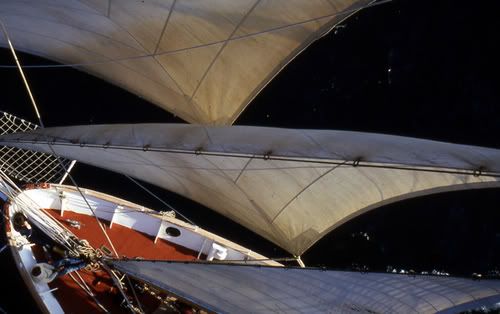
Fair Sailing Sometimes it is hard to decide just when a journey began. Many points in time could justly claim to be the true moment of departure, but which of them most deserves the honour of
being remembered as the instant when the journey really began? The journey I would like to tell you about had a clearer starting point than many others I was lucky enough make. But almost as though to compensate for this clarity, that starting point is wrapped in another kind of mystery, which I never resolved to this day: just why I was chosen to make the journey, and by whom. The journey in question started on a sunny day in March, nearly twenty-five years ago, my final year of school. The school was and I dare say still is housed in tall neo-gothic buildings standing around grassy quads, in the Fens on the outskirts of Cambridge, not far from the River Cam itself. The journey began in the great hall where we ate our meals. It was a high, often gloomy place with portraits of past headmasters and Old Boys who rose to fame hanging on the walls. At one end of the hall there was a raised platform where the School Prefects and Heads of Houses dined at Top Table with whichever two or three masters were up that day. At the start of each meal the entire school would mindlessly chorus grace before digging in. The food was of a consistently high and traditional standard of nastiness. A man who was once held prisoner for several years in a Teheran gaol on a charge of espionage said on release that it was not too bad for one who had been in a British public school and the British Army. The rubber fried eggs could have been used as weaponry. But I digress... at the end of lunch, the Head Boy would read out the day's notices: sporting engagements with other schools, the results of matches and races, the award of colours and half-colours to the meritorious, chapel services, extra-curricular activities, notable achievements. And, last but not least, he would read out the names of boys summoned to the headmaster's attention following scrapes with the townies, drunkenness discovered, spectacular practical jokes and other such gate-able infractions of the Eleventh Commandment: Thou Shalt Not Get Caught. My journey began at the moment when I heard my surname in this list. Wondering what I had done to earn the dubious honour of an audience with the headmaster, at the appointed time I traipsed along to the house where he and his family lived. It stood in the school grounds but somewhat removed from the other buildings. I was a little surprised to find that he greeted me with a smile and invited me into his living room. A gentleman was waiting there whom I had never seen before, and never saw again afterwards. I remember him well still: middle-aged, neither tall nor short, sandy hair, a moustache, the uniform of an RAF officer. I was introduced to him, but was never told his name. The headmaster said a few words then retired, leaving me alone with the officer. He posed a few questions concerning my background, activities at school, hobbies and so on. And then he asked, I took my leave and spent the next week wondering what the hell that was all about and dreaming all kinds of adventurous things which an RAF officer might conceivably have up his sleeve. At last a parcel arrived for me in the mail and all was revealed. The parcel contained a letter of invitation to spend two weeks on board the ship Sir Winston Churchill, a splendid three-masted schooner which belonged to the Sail Training Association, a British charity whose aim is to spread and increase knowledge and the love of sailing traditions - a mission they succeed in exceedingly well. The letter explained that the journey would cost me nothing beyond transport to and from the ship, all other costs already being covered by others, my mysterious, anonymous benefactors, I guessed. The parcel also contained a manual, packed with information concerning the ship, which I would be expected to have down pat by the time I went aboard, a list of knots to be tied eyes closed, a list of the things to brought along - clothing, towels, wellies, a seaman's knife with a sharp spike and so forth. I was to rendezvous with the ship in late August at a place I had never even heard of before called Hartlepool. Checking a map it turned out to be a port on the north-eastern coast England, not far from the Scottish border. Questions to my classmates soon revealed that just one other boy in the school would travelling on the Churchill that Summer, but on an earlier cruise than mine. The introductory material in the parcel sounded a little daunting as it explained that hard, cold, wet work could reasonably be expected, that this was not a holiday, but rather an adventure The summer term and A-level exams were a nightmare and I felt happy as a sandboy when at last they were over. The weeks leading up to the start of the cruise passed in a flash and in no time I found myself on a train heading north, still trying to get the names of sheets and sails, lines and ratlines, masts, yards and halyards into to my skull. The weather was overcast when I arrived and when I finally reached the right dock I found the Churchill waiting there with a clutch of lads waiting to go up a gangway on board. The Churchill is one of the most elegant and beautiful tall-ships I have ever seen. She is a square-rigged topsail schooner, three masts, 300 tonnes, 153 feet fore to aft, 25 foot in the beam. The three masts are 112 feet high. All is designed and realised with function and efficiency in mind rather than luxury or refinement. Nonetheless she is a fine-looking ship, an elegant black hull of lean proportions, graceful at sea, a true beauty to behold. When at last it was my turn to come aboard, a fellow who looked not much older than I was ticked my name off a list and said "Welcome on board. You're in Fore Watch. Over there please. Next." Wondering what this meant, I followed the previous lad heading through a hatchway in the foredeck and down to a ladder to find myself in a large open cabin which occupied the entire bow of the ship. This was to be my home - my bedroom, refectory, living room and occasional lounge - for the next two weeks. Light came in dimly from above through opaque sky-lights. Bunks lined the bulkheads, following the curve of the bow. Two long tables with fixed benches down either side stood along the centre-line of the ship. A half-dozen new arrivals were already standing there, all unknown, all looking more or less as uncomfortable as I felt in those unfamiliar surroundings, wondering what to do next. Before long a cheerful fellow came trotting down from above wearing jeans, a blue woolly hat and a t-shirt with the ship's logo on it. He introduced himself as our Watch Leader and showed us where to stow our kit in lockers under the bunks. Then he lead us back out onto the deck and explained that the first thing we would need to do was to put on a harness, swarm up the ratlines to the higher of two yards (cross-beams from which the square sails hang) up on the fore mast. Once up, we should clip the harness onto a rail running along the yard, make our way out to one end, then back out to the other other end, then back down again. Easy. Hold tight, don't fall off and anyone not up to it better get back on shore sharpish because we'd be doing this all the time at sea. Going up the ratlines wasn't too bad. They did shake around somewhat but it was OK. Getting into the crows nest was a trickier and tenser affair than I had imagined. It looked quite a long way up seen from the deck, but the deck looked miles away below from up there. Even though the ship was securely moored, up in the crows nest you could feel it swaying gently from side to side. Pretty hairy. The stretch from the crows nest to the upper yard was up a half-dozen rungs welded onto the front of the mast. Getting from the last rung of the mast onto the line, hanging in long loops below the beam, was not easy at all. I seriously wondered whether I would be able to do it, even whether I was up to this journey or not. The deck was a very long way away indeed. Falling would not have been funny in the least and there was nothing at all to stop you. Somehow I managed to get up there, all my weight leaning on the top of the beam, my feet shakily on the rope underneath, the deck and the slatey-grey sea far far below. 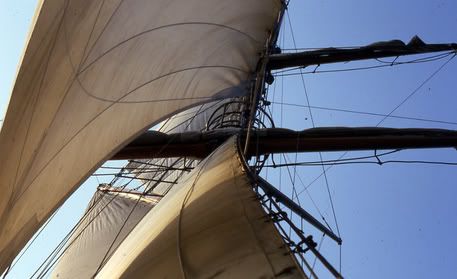
There was the little rail along top of the beam. I clipped the safety-harness onto it and started edging out. Joints in the rail meant that every couple of yards you had to unclip the harness and clip on again. By the time I reached the far end I was sweating. For the only time I can remember in my life, my knees trembled with tension, against my will, nothing I could do about it. Soppy you say? Well, if you've done it then you're right - otherwise just try! Still, I made it alright and started back out to the other end. Strangely, as I edged my way back, the fear and tension began to ease off and by the time I got back down on deck again I was feeling very pleased with myself, half a sea-dog already. A mug of over-sweet tea from the galley was very welcome as I fell to chatting with the other lads coming down from their ordeal by height. We were not given long to loaf around with small-talk. Soon we were all assembled on the after-deck and addressed by Captain M. Kemmis-Betty. He introduced himself and the other members of the permanent crew - the Chief Officer, Boatswain, Purser, Engineer and Cook - and then the three Watch Officers and Watch Leaders, one for each of three teams, one team for each mast. Next the Captain outlined our planned route: east across the North Sea to Amsterdam, where we would stop for a couple of days, then south down the English Channel, possibly to France somewhere, weather permitting, then back to Southampton at the end of the cruise. Moorings were cast off and under engine power we nudged away from the dock and out into the sea. The engines were used for the first hour or so, with a pilot on board as we negotiated our way away from the coast avoiding shoals and sandbanks under low grey skies. Then at last we were properly out at sea. Now were sent up in earnest for the first time. Making rather a mess of things as our Watch Leader yelled out instructions and more-or-less friendly insults, we eventually got the sails set. The engines were switched off and we sailed. The wind was light to fresh and we made four or five knots, rolling and pitching gently away from England, hearing the creaking of sails and ropes pulling in the wind for the first time, the rush and crash of the sea against the hull. In the following days we followed a steep learning curve about a whole new way of life. Nothing was as we had known before - neither surroundings, nor company, nor tasks, nor weather, nor language, nor hours of rising nor sleeping. Even attending to nature's calls was different - squatting in cramped uncomfortable heads, rocking and swaying with the swell, flushing the stuff away with hand-pumps and with the dread that the damned things might jam and require filthy manual reparatory intervention. Our days were split into four-hour watches, one on, one stand-by, one off; our nights into three-hour "dog" and "graveyard" watches. Nobody ever got more than four hours' rest in a row, and if the weather got up and the sails needed handing, then all hands were called on deck and that was sleep up the spout. When off watch there was time to eat, try to catch up some sleep, keep a log, keep out of the way. By the second day at sea all fear of heights was utterly gone and I wondered how I had had any to begin with. It was an exciting pleasure to be high up above the ship in the wind, swaying and soaring as we trimmed or sheeted-in the sails of hard heavy canvas, herring-gulls gliding past at the same height, streamlined as interceptors, hard hungry yellow eyes scanning for any scrap of food. 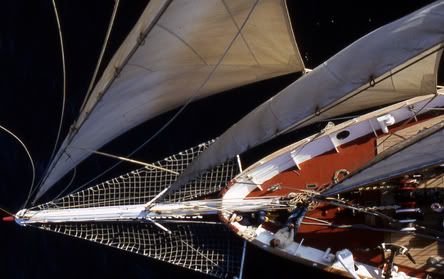 The hardest watches were look-outs by night on the bridge, in the graveyard watch. These started at three in the morning, with all the Watch feeling more dead than alive, cold and damp, missing our nice warm bunks yet needing to stay awake and alert, looking out for other ships or obstacles, or if at the helm, then watching the course on a compass lit in dim red light so as not to spoil night-vision. Other duties tackled ferociously had to do with keeping things ship-shape. Order and cleanliness, not to mention good working order of all parts, were pursued maniacally. There was a standing competition between the Watch Leaders and the crews - the leaders trying to find dust or dirt somewhere on the ship - passing a finger along tubing or behind a bench - the crews trying to make sure there was none to be found. All the forty or so boys on board had a turn or two at being galley-rats - helping to prepare meals and clean up afterwards. "Spud patrol", involving the arduous peeling and rinsing of thousands of potatoes, was hated by some, enjoyed by others who did not resent a chance to sit and chat like grannies while doing something like useful work. Crossing the North Sea from Hartlepool to Amsterdam took some three or four days, sailing without halt. The wind was never stronger than 3 or 4 Beaufort, so it was all reasonably gentle going. The weather was mostly overcast, but occasionally the skies would open enough to let beams of silvery sunlight cast down onto the pewter surface of the waves. Little by little we all got used to life on board and began making friends with other fellows in the crew. There was no common denominator other than the English language and the fact that there were no girls or women on board. The STA also runs cruises for girls but, as far as I know, never mixed cruises. Aside from any other considerations, the ship did not have the facilities for a mixed crew. Most of the boys were English, but there were also a Canadian and one or two other nationalities. Boys from private schools were the exception rather than the rule and nobody paid any attention to background at all. Ability and cordiality were all that counted. At least, they were until one day we had squalls of rain and had to don wellingtons. I had bought mine at a sailing shop in London and they were a bright canary yellow. Rather smart too, I thought. Little did I know that my yellow wellies were to cause howls of derision from the other lads. It turned out that yellow wellies were considered the hallmark of yachtsmen, who for reasons unknown were considered effette, hopeless week-end sailors, nothing at all like Proper Sea-going Mariners such as we were after three days on board. Yellow wellies were worn only by snotty yachties. In the end I lived it down. At least they weren't white wellies, which are apparently even worse than yellow. Just in case you were wondering, the acceptable hues for wellies are black or dark blue. Friendly rivalry was encouraged between the three Watches concerning speed and precision in handling the sails. Getting the sails set was the least tricky task. Furling them was the hardest. The sails are astonishingly heavy and stiff and getting them tidily furled away below the cross-beams was considered a mark of a job well-done, and any loose ends flopping about taken as rotten slovenliness. The foremast bore more than twice as many sails as either of the other two so we were always last to have the job done, but we still considered ourselves in some way special because we had that much more to try and learn and do, and were the only watch constantly going aloft to manage our tasks. 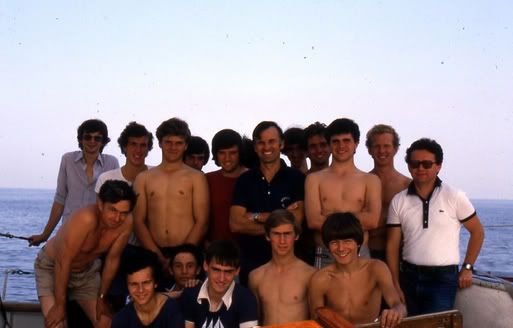 Captain Kemmis-Betty with members of the Fore Watch and some permanent crew-members. We entered Amsterdam harbour on a sunny afternoon and made quite a show of it. All the sails were furled as we came in under engine-power. All the boys of the crew were deployed on the ratlines and yards so as to make a kind of pattern. Docking the ship was not an easy business and took some time, but at last we got safely moored. We stayed at Amsterdam for a couple of days and the ship was open to visitors for some of the time. We took turns in showing little groups of guests around and answering their questions about the parts of the ship, how life was on board, how we came to be there and so on. When not engaged in cleaning and repairing, we were allowed ashore and told to take care. Of course the first thing we all did was to slope off gawking around Amsterdam's famous red-light district. For an hour or so it was strange and interesting to see the whores posing in shop windows, then we went off for a beer or three. The following day we opted for something a little more highbrow and visited the Rijksmuseum, which hosts the world's richest collection of Flemish and other northern Old Masters, and the Van Gogh Museum, which had opened in a brand new building not long before. Two episodes remained in my mind from that day. One was the sound of a fellow playing steel drums in a long tunnel which, if I remember rightly, lead underneath the Rijksmuseum itself. It was the oddest and most haunting of sounds. The other episode ocurred when we came into the salon of the Rijksmuseum where an entire wall is filled by Rembrandt's famous and striking masterpiece "The Night Watch." 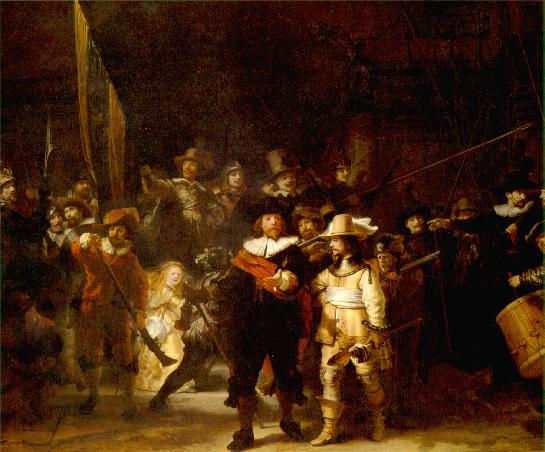
The company of Frans Banning Cock preparing to march out - Rembrandt van Rijn - www.artchive.com. There was a hushed and reverent silence in there, with people pointing discretely at this or that detail and making informed considerations to eachother in whispers. One of the fellows from our crew stepped into the room, looked up at the painting and in a not-exactly-silent voice said: "Cor! Fuckin' amazing!" thus earning sniggers from some and arched eyebrows from others in the room. I'm still not sure how spontaneous or sarcastic or otherwise this comment was. In due course we left Holland and made our way back out into the North Sea. After a couple of days the wind fell completely and we stood becalmed, not moving an inch. It was warm and sunny and in the end some netting was tied to the side of the ship and the braver or more foolish of us went in for a dip. The dip turned out to be very quick indeed for the water was freezing in spite of the nice warm day making it look like the Med. The stop also made a good photo opportunity. We put a dinghy into the water and puttered a little way away to take snaps of the Churchill at sea and to see what she looked like from a distance. 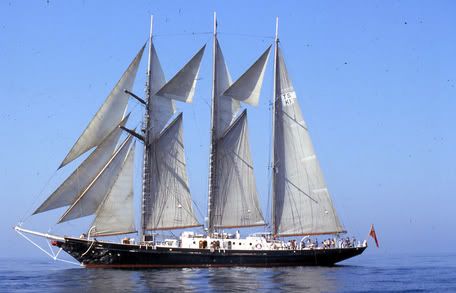
After our little swim we were set to giving the decks a good scrub and some other extra cleaning and tidying tasks. One of the Watch Leaders, who was a Cornishman, emerged from below with an accordion and settled down to play sea shanties. He had quite a repertoire and the music gave the ship an air of olden times. 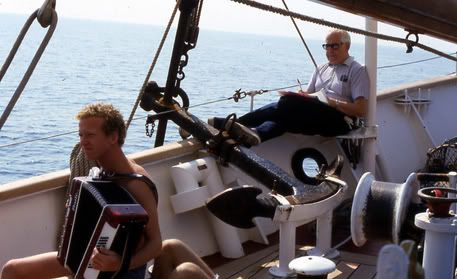
Finally the wind came up again and we turned south, sailing down towards the Channel. One late afternoon, just as I was snoozing off in a break I heard shouts, people running, something about something overboard and then a call for all hands on deck. The sails were being dropped in a rush, the engines were switched on the ship circled round, the people round the helm looking out with binoculars and pointing at something in the water. Nobody in my watch seemed to really know what was going on. We could hear something about a pigeon overboard, but that made no sense at all. The ship circled round a couple of times and the something was fished out of the sea with a net from the stern. 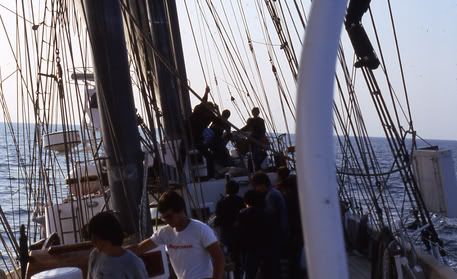
Afterwards at dinner the matter was explained. A pigeon had landed on the end of the boom and someone had thrown something at it for no good reason. By sheer chance he had hit it full on and knocked it out. The poor bird had fallen into the sea and seeing this the Mate had ordered "Pigeon Overboard", thus setting into motion the entire Man Overboard procedure, in truth as a practice run, but also by the way saving the life of the poor old pigeon, who spent the next few days convalescing in a cardboard box. Sailing in the Channel we were all extra attentive, partly because we all knew that this is a particularly busy part of the sea, with a great deal of maritime traffice, mostly heading east-west while we were sailing from north to south; and partly because the barometer began falling and the wind freshened up to Force 5 or 6 Beaufort. These are not storm conditions of course, but still did seem quite brisk to us. I remember feeling pretty cold and wet on several occasions, with hands getting blue and numb as we handed the sails. Still, I was protected by heavy plastic oilskins over a good thick jersey, a towel round my neck to keep the water out, and I wondered how the sailors had coped in the old days, when such luxuries were presumably not available, and when the men were aboard for an indefinite time, not a two-week cruise, often going to war, a good proportion of the crews literally kidnapped off the streets into His Majesty's service by press-gangs. It must have been very tough indeed, both physically and psychologically. The officers must have been quite extraordinary men in those cases in which they succeeded in creating succesful, efficient and tight-knit fighting teams, as many did. We sailed down the Channel without any particular event and put into the French port of St. Malo. Here we moored at docks near the bastions encircling the old part of the town. From aloft I could see across the roof-tops, an extensive yachting marina, and people in the streets below. The permanent crew organised a running race around the walkway along the top of the city walls - perhaps a mile and a half all told. Our stay at St. Malo was briefer than that at Amsterdam and we set off again after an overnight stop. From St. Malo we set course to Southampton. I remember one night seeing a vast orange dome of light on the horizon. On asking I was told it was the lights of the small Channel Island of Jersey. It made me wonder how much light-pollution our big cities generate - a query answered by satellite photography some years later. As we drew nearer to Southampton we were once again set to cleaning the ship and getting everything up to a high level of shine. This was in preparation for the guests of honour we would be taking on board once we came in to the Solent - a huge bay between the port of Southampton and the Isle of White. In due course a small group of dignitaries came out to the Churchill in a motor-launch and transferred on board. Then came a surprise - the Churchill's sister-ship, the Malcolm Miller was also there in the Solent, and the two ships were to race eachother. It was not a proper regatta, just a test to see which crew could get more knots out of their ship under full sail. To see another ship, almost identical to our own, all sails out in a fresh breeze, was a sight never to be forgotten. I think it was a sight that stirred the hearts of many, for our two schooners were soon escorted by several large and beautiful offshore racing yachts, their crews all casting admiring looks at the schooners. What it must have been to see the great tea-clippers of the nineteenth-century, the Thermopylae, the Cutty Sark and others, racing across the high seas carrying their loads of tea back to England. When our cruise finally came to an end a tug-of-war was arranged between the crews of the Churchill and the Miller. And then it was really over. All of us felt glum as we left the ship. It was very strange: perhaps because of the amount of care and attention lavished by all, continuously, on the ship, perhaps because of its nature as a great, complex, beautiful, moving thing, for one reason or another we had all come to love that ship with a fierce pride. It seemed easier to understand the stories of tough sailors in tears when their ships were sunk, to understand why a ship is always called "she" - as if it were a person. My two weeks on board the Churchill were without doubt one of the most exciting, interesting and formative journeys I ever made. I would recommend a cruise on an STA schooner strongly to any young person who has the opportunity. Looking back at some of the printed material which was sent to me before the cruise, I found these two extracts from a talk which HRH Prince Philip, patron of the Sail Training Association, gave to trainees: "This is a scheme designed to benefit the young people of this country, to give them a taste of fright, discomfort and adventure in an age in which it is possible to live comfortably, securely and boringly." "The best moments in life and the ones which leave the deepest impressions are not necessarily all pleasure. Meeting an exacting challenge as a member of a team brings out unexpected qualities and hidden strength." I think the Duke of Edinburgh's words captured the essential aspects of the experience very neatly. Times pass. The Winston Churchill and Malcolm Miller have in recent years been replaced by two fine new brigs, the Prince William and the Stavros Niarchos. The Sail Training Association has become part of the Tall Ships Youth Trust. It looks like the trainees have cooler shades than we did too. But it is fair to guess that much of the spirit has remained the same. If you would be interested in further information on the TSYT and its activities, either for yourself or for young people you know, then here is the address of their site: www.tallships.org 
Text and photographs copyright July 2005 Amenon - croc996 @ yahoo.com |